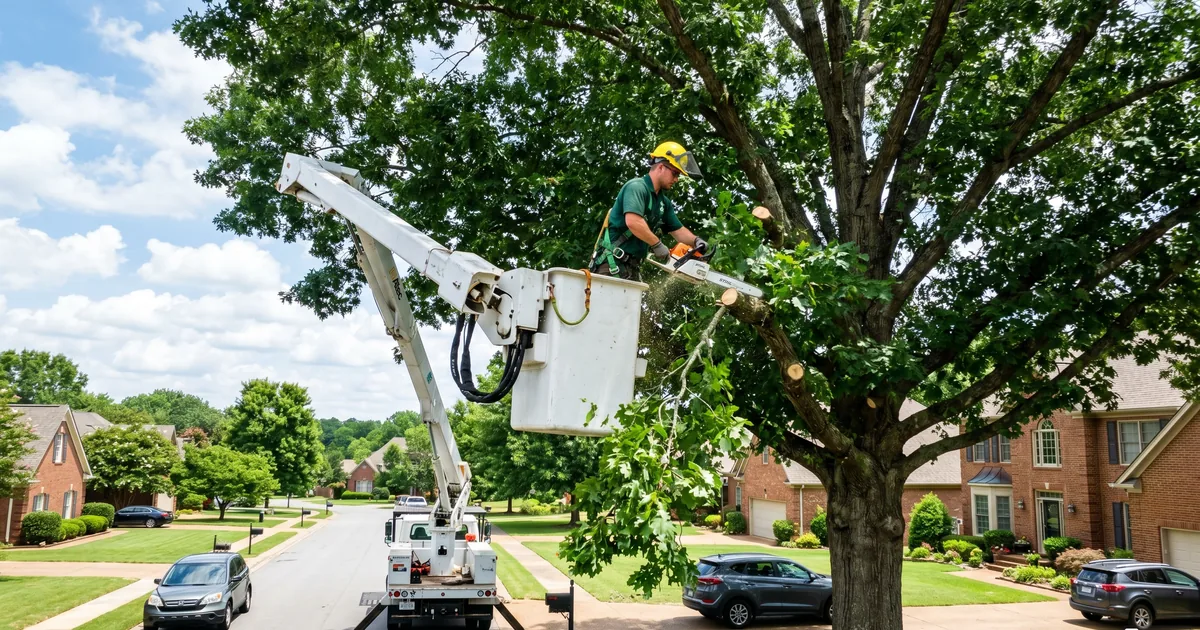
ISA-Standard Pruning - Madison County, AL
Crown cleaning, deadwood removal, structural pruning, and clearance cuts - done right the first time. We don't top. We don't stub. Free estimates throughout Madison County.
Free Estimates · Oak Wilt Safe Practices · All Madison County
North Alabama's weather is unforgiving on trees. Huntsville sees violent spring thunderstorms, summer heat and drought stress, and periodic ice storms that load branches beyond their limits. Trees with poor structure - co-dominant stems, included bark, excessive end-weight, or dense crowns - fail when the weather turns.
The most common injury we see isn't storm damage. It's damage caused by bad trimming. Flush cuts that destroy branch collars. Topping that creates decay columns. Stubs that die back and invite fungal rot. These cuts don't just look bad - they structurally compromise the tree for years.
ISA-standard pruning cuts at the branch collar, never through it. The branch collar is the swollen tissue ring where the branch meets the trunk. Cutting just outside that ring - not flush, not stubbed - triggers compartmentalization and allows the tree to seal the wound. That's the science behind every cut we make.
Oak Wilt Advisory - Huntsville Area
We do not prune oak trees between March 1 and June 15. Nitidulid beetles are active in this window and carry Bretziella fagacearum spores directly to fresh pruning wounds. A single misjudged cut can kill a mature oak within weeks. Schedule oak trimming November–February for zero risk.
Every job is scoped to the tree's specific needs - not a cookie-cutter haircut.
Removal of deadwood, dying branches, and crossing limbs from the canopy. Reduces failure risk and improves aesthetics without changing tree shape.
Reduces overall canopy size to decrease wind load, clear structures, or manage height. Done by reducing to lateral branches - never by topping.
Removal of lower branches to improve sight lines, clear structures, driveways, and pedestrian paths. Removes no more than 25% of live crown in one session.
Targets co-dominant stems with included bark, weak branch attachments, and crossing scaffold branches. The most important pruning for long-term tree safety.
Pruning for structure clearance - rooflines, gutters, fences, utility lines (above OSHA 10-ft contact zone), and neighboring property lines.
Pre-season crown work to reduce wind sail, remove weak attachments, and cable co-dominant stems before tornado season (March–May) or ice storm season (Dec–Feb).
No Topping
Topping cuts main trunks to stubs. It destroys the tree's structural integrity, creates large decay columns, triggers weak epicormic growth, and causes more hazards than it prevents. Any company that tops trees is practicing bad arboriculture.
No Flush Cuts
Flush cuts remove the branch collar - the tree's primary wound-closure tissue. Without the collar, the tree cannot compartmentalize. Decay spreads inward. Every cut we make is outside the collar, not through it.
No Wound Sealant
Tar, paint, and pruning sealants trap moisture and block the tree's natural compartmentalization response. ISA and ANSI A300 standards both advise against sealant use on pruning wounds. We leave clean cuts - the tree handles the rest.
No Oak Trimming Mar 1–Jun 15
We enforce a hard stop on oak pruning during beetle flight season. If a competing company offers to trim your oaks in April or May, they are putting your trees at risk of oak wilt infection. We won't do it regardless of urgency.
| Tree Type | Best Window | Avoid | Reason |
|---|---|---|---|
| Oak (all species) | Nov 15 – Feb 28 | Mar 1 – Jun 15 | Oak wilt beetle flight season |
| Crape Myrtle | Late Jan – Feb | Mid-summer | Avoid heat stress; never top |
| Dogwood | Late fall after leaf drop | Spring flowering period | Preserve bloom buds formed prior fall |
| Maple | Late winter (Feb–Mar) | Early spring sap flow | Sap bleed (harmless but messy) |
| Pine / Evergreen | Late winter, early spring | Fall/summer active growth | Minimize resin exposure wounds |
| Fruit Trees (peach, apple) | Dormant (Jan–Feb) | Late summer / fall | Late pruning removes next year's fruiting wood |
Pricing depends on tree size, location, access, and site conditions. Call (256) 203-1967 for a free on-site estimate - no obligation.
ISA-Standard Pruning
We cut at branch collars per ANSI A300. No flush cuts, no stubs, no topping - proper technique that promotes healing.
Oak Wilt Awareness
We respect the March 1–June 15 oak wilt transmission season. We won't trim oaks during peak nitidulid beetle activity.
Licensed & Insured
Full liability and workers' comp coverage. We provide proof of insurance before any work begins.
Complete Cleanup
All clippings and debris removed from your property. Your yard is clean when we leave.
We serve all of Madison County and surrounding areas. Call to confirm service at your address.
Call now or request an estimate online. We'll assess your trees and provide a written quote with no obligation.
(256) 203-1967Free Estimates · No Pressure · All Madison County
How much does tree trimming cost in Huntsville AL?
Cost depends on tree size, canopy density, access, and number of cuts. Call (256) 203-1967 for a free written estimate on your specific trees.
When is the best time to trim trees in Huntsville?
Late fall through early spring (November–February) is ideal for most deciduous trees in Huntsville - they are dormant, wounds seal faster, and there is no foliage to obstruct work. Oak species must never be trimmed March 1–June 15 due to oak wilt beetle season. Call us for species-specific advice.
What is the difference between trimming and pruning?
Trimming focuses on size management and aesthetics. Pruning is targeted structural work - removing deadwood, co-dominant stems, and crossing branches for long-term tree health and safety. Professional tree work always uses ISA-standard cuts at the branch collar regardless of the job type.
Can you trim trees near power lines in Huntsville?
OSHA 1910.269 requires minimum 10-foot clearance from energized lines for unqualified workers. We handle clearance pruning up to the 10-foot contact zone. For branches within that zone, we coordinate with Huntsville Utilities (256) 535-1200 or TVA (1-888-882-4703) - line-clearance work is their responsibility and is performed by their certified contractors.
What is crape murder and should I be concerned?
Crape murder is the destructive practice of topping crape myrtles by cutting main trunks back to stubs. It creates ugly knuckles, weak epicormic growth, and accelerates structural failure. If your crape myrtle has been topped before, remedial pruning can improve form over several seasons. We never top - proper crape myrtle work removes only crossing branches, suckers, and spent seed pods.
This website is operated by an independent lead generation company and is not affiliated with any specific service provider. Huntsville Tree Removal Co does not perform services directly.
All work is carried out by licensed, insured third-party contractors. We make no representations regarding the quality, safety, or legality of services provided by referred contractors. Use of this site is subject to our Terms of Service and Privacy Policy.